
When Images Start Talking
When you use an image as a story starter, you’re not beginning with a blank page. The visual world has already begun to take shape. The writer’s task is to discover who is speaking, what is happening, and where the story might lead. By pairing an image with a distinct narrative voice, you can construct powerful, voice-driven micro-stories (under ten paragraphs) that are deeply satisfying to write and incredibly engaging to read.
The stories I write are micro-stories. Writing a larger story, at least for me right now, can feel a bit overwhelming. One of my favorite micro-stories is a tale about a terrifying, ancient planetary defense weapon trapped in the body of a cute cartoon mascot. I’ll use that story as an example of how an image can spark an entire narrative.
1. The Visual Anchor: Launching, Not Explaining
A visual anchor is an image used as a creative springboard, using the emotional and structural foundation you “see” to launch your story idea.
Consider the image I used. It’s an image of a creature:

The literal description of what it looks like:
A creature standing alone on cracked earth. It has a massive, egg-shaped white head with deep cracks, small nostrils, and piercing red eyes, wearing a tattered blue cloak. It has long, sharp claws.
What a Visual Anchor springboard looks like:
Taking the contrasting elements of the image—the fierce, glowing red eyes and menacing claws paired with the bizarre, but with an oversized, almost comical egg-shaped head—I asked myself: What if this terrifying creature is not at all what it seems to be?
By utilizing the image as a springboard rather than a blueprint, the visual elements translated directly into narrative tension. The cracked, organic texture of the head became an ancient exterior shell. The glowing red eyes became active viewport lasers. The sharp claws became structural stabilizers or hidden weapon ports.
2. The Narrative Voice: The Art of the Perspective Shift
Once the image establishes the mood, the narrative voice gives the story shape. The voice determines how the story is told, influencing the prose style, vocabulary, and pacing.
In my example story, I used contrast between the comicbook-like visual appearance and the internal voice:
“I’m ready, ready for a fight, ready to defend our home planet against enemies that threaten us from the skies. I have twelve weapon ports and a modern array of firepower that can pulverize and obliterate any craft of any size.”
Why This Voice Works
• First-Person Clinical Detachment:
The narrator speaks with the cold, analytical, and literal perspective of an AI or ancient machine. Everything is reduced to systems, procedures, and tactical assessments.
• The Irony of the Form:
Because the reader is looking at a visual that resembles a strange, goblin-like cartoon creature, the hyper-serious militaristic internal monologue creates immediate and compelling contrast.
• The Misunderstanding Engine:
The entire plot hinges on a disconnect in voice. The AI interprets human play, graffiti, and festivals through the only lens it understands: warfare analysis. It can process “stealth objects” and “payloads,” but it is completely unequipped to decode reverence, ridicule, or fun.
3. The Power of the Micro-Story Format
A story doesn’t need to be long to be meaningful. In many ways, the micro-story format—focusing on a tight, voice-driven narrative arc—offers unique advantages.
• It’s Doable:
Writing a self-contained narrative in under ten paragraphs feels manageable. It bypasses the mid-project fatigue that often stalls larger writing efforts.
• High Impact, Fast Delivery:
A short format encourages focus. Most sentences contribute to establishing the voice, advancing the internal logic, building atmosphere, or escalating tension.
• Complete Creative Satisfaction:
Finishing a piece of writing provides a tremendous feeling of accomplishment. For me, limiting the scope of the piece means I don’t need extensive worldbuilding, dozens of characters, or sprawling subplots. I can take an idea from an image and turn it into a complete and satisfying creative work.
Find Your Anchor
Find images that somehow “speak to you,” even if you don’t know what they’re saying just yet. One day a few words or sentences may come to mind. When they do, return to that image and start writing.
I’ve discovered that I don’t need a massive worldbuilding bible to create a compelling universe. Sometimes all it takes is a single image, a distinct voice, and the willingness to see where that voice leads.
Not sure where to begin? Browse a few of the images and their three accompanying story ideas here on this site, and see how a narrative voice can emerge when you look beyond the obvious.
You may discover that the next story you’ve been searching for has been quietly waiting inside an image all along.
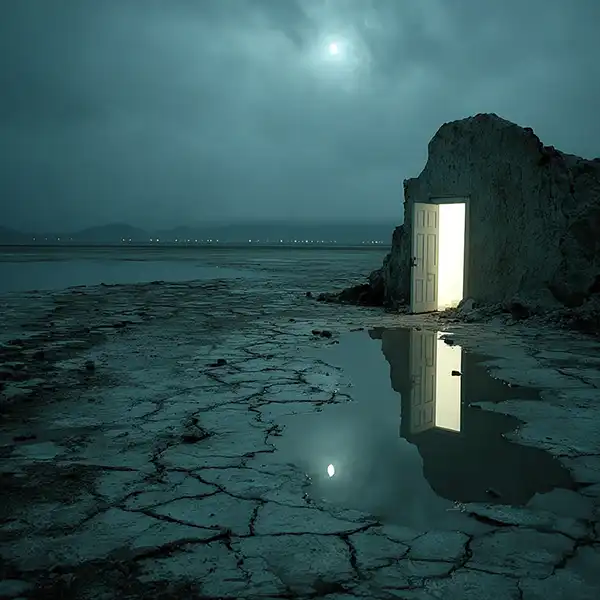
Click see a unique image and three story possibilities.