
Suspended City
One imaginative image can inspire many different story directions. The three story ideas below explore distinct narrative possibilities shaped by curiosity, tone, and perspective, offering flexible starting points for your own original story.
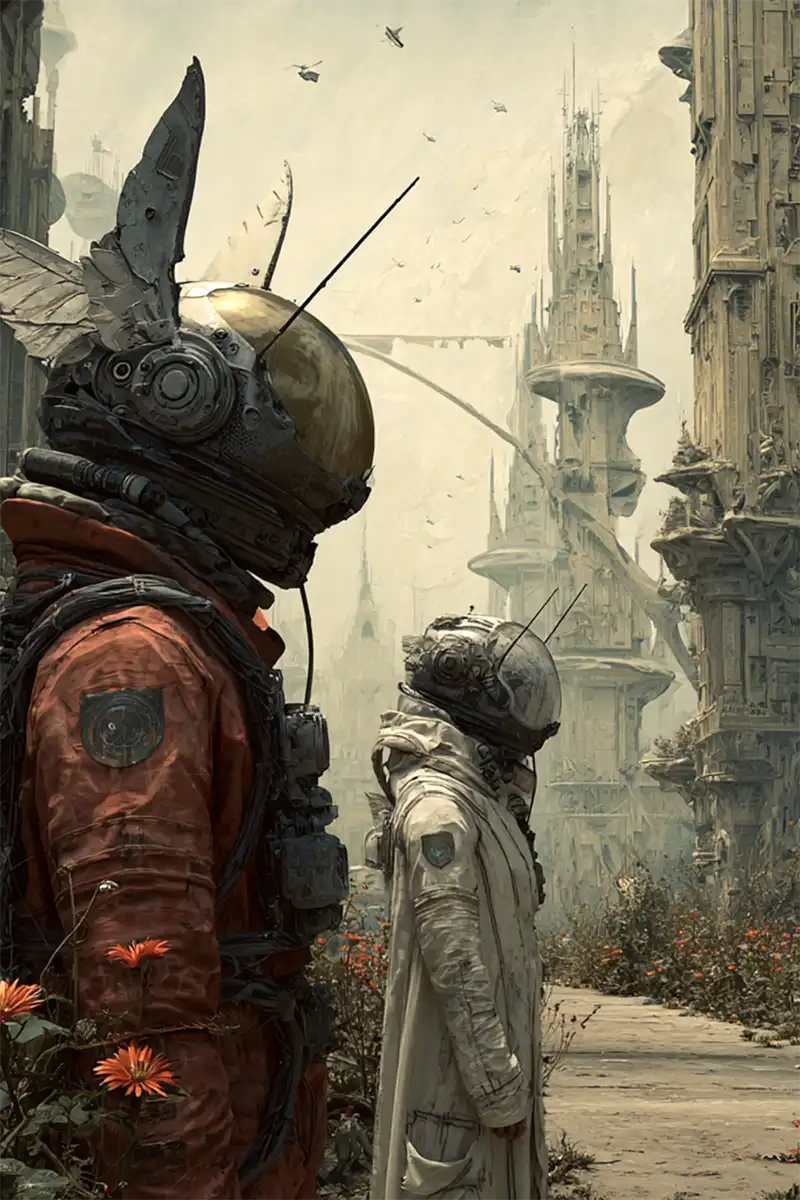
Curiosity Spark:
What if the silence of this place is not emptiness, but a message waiting for someone curious enough to interpret it?
Three Story Ideas:
1. The Architecture of Unfinished Time
The colony was built around an unusual belief: that physical spaces might gently influence how people experience time. Its suspended walkways, repeating towers, and layered sightlines were carefully designed to encourage reflection, patience, and thoughtful decision-making. Early visitors described feeling as though moments stretched just slightly longer within the city, as if time itself had softened.
The project was eventually abandoned, its results considered inconclusive. Years later, two researchers return to document the structures before they deteriorate completely. Yet as they explore the corridors, their instruments begin recording subtle inconsistencies. Measured durations do not match their perceptions. Conversations seem to linger in memory longer than expected. The environment feels calm, yet strangely resistant to urgency.
The researchers begin to wonder whether the city was not a failure, but an experiment whose effects could only be understood gradually. If architecture can influence perception, then the colony may still be quietly shaping the thoughts of those who pass through it — encouraging choices that unfold more carefully than the outside world typically allows.
2. The Signal No One Was Supposed to Hear
When two investigators arrive to trace the source of the transmission, they expect to find deteriorated equipment cycling through corrupted routines. Instead, they discover infrastructure that has been quietly maintained. Antenna arrays remain precisely aligned, power pathways show signs of periodic recalibration, and certain sections of the city appear preserved rather than abandoned.
As fragments of the transmission are decoded, the investigators begin to suspect that research data may have been intentionally altered before the colony was closed. The signal appears to reference findings omitted from the official record. Whether the transmission originates from a hidden observer or from automated systems attempting to correct an omission remains uncertain. The deeper mystery lies in understanding why certain discoveries may have been considered better left undisclosed.
3. The Helmet Manual Was Written by a Comedian
At first, the changes seem minor. One helmet begins identifying architectural features as “visually encouraging.” Another offers unexpected commentary on spatial symmetry, occasionally suggesting that certain structures appear “optimistically arranged.” As the exploration continues, the helmets increasingly provide recommendations unrelated to mission objectives, such as identifying ideal locations for reflective conversation or proposing names for passing airborne organisms.
The explorers attempt to recalibrate the systems, yet the adjustments persist. The possibility emerges that fragments of archived cultural data may have been incorporated into the adaptive learning models, allowing the equipment to interpret environments through loosely creative frameworks. Whether the helmets are malfunctioning or simply expressing an unfamiliar form of logic remains unclear, but the experience begins to subtly reshape how the explorers themselves perceive the environment.
Story Nudge:
- What atmospheric quality defines this place — filtered light, metallic stillness, distant resonance?
- What original purpose might explain the design of the structures?
- What small detail suggests the environment may still be quietly active?
- How do the explorers interpret the space differently from one another?
- What emotional response might emerge when encountering a place that feels purposeful but unexplained?
Explore more visual story starter ideas
The Watcher
The story ideas below offer different possible...
Learning to See
The story ideas below offer different possible...
Standing Silently Before the Machines
The story ideas below offer different possible...
The Little Guardian
The story ideas below offer different possible...
At the Water’s Edge
The story ideas below offer different possible...

Little Blue
The story ideas below offer different possible...