
What Happens After the Story Is Written?
Stories have a habit of refusing to stay where they started.
An idea may first appear as a few notes in a notebook, a scene scribbled on a scrap of paper, or a brief story inspired by an image. It feels complete enough at the time, yet something about it continues to linger. A character remains in the imagination. A setting refuses to fade. A question continues to echo long after the writing session has ended.
That lingering quality is often where another creative journey begins.
We tend to think of storytelling as a destination. The story is written, the project is finished, and attention moves elsewhere. In reality, stories often become starting points for entirely different forms of creativity.
A writer imagines a place and later sketches it in the margin of a notebook. A scene inspires a collection of photographs. A short story evolves into a comic, a classroom project, a piece of digital art, or a short video created simply for the enjoyment of seeing an idea take on a new shape.
The original story remains important, but it becomes only one expression of a larger creative impulse.
This is one reason images and storytelling work so naturally together. An image rarely tells a complete story. Instead, it creates possibilities. One person notices a mystery. Another notices a relationship. Someone else becomes fascinated by a small detail hidden in the background. Each observation leads in a different direction, and each direction has the potential to become something uniquely personal.
Creative expression rarely fits neatly into categories. People who enjoy writing often discover that they also enjoy sketching characters, building imaginary worlds, creating visual journals, designing maps, collecting reference photographs, or experimenting with simple video projects. The boundaries between creative activities are often far more flexible than they first appear.
- A story can become a sketch.
- A sketch can inspire a scene.
- A scene can evolve into a sequence of images.
- A collection of images can suggest an entirely new story.
The creative process is rarely linear.
This can be encouraging for anyone who feels intimidated by the idea of writing something large or ambitious. Not every creative idea needs to become a novel. Some ideas are better suited to a single illustration. Others may become a page in a journal, a short animation, or a collection of notes that eventually inspire something unexpected months later.
The pressure to create finished work sometimes causes people to overlook the value of creative exploration. Yet some of the most rewarding projects begin without a clear destination. They begin because a particular image, question, or story fragment captures the imagination and refuses to let go.
For those searching for story inspiration, this can be a useful reminder. The goal is not always to find a perfect idea. The goal is often to find an interesting one. An idea that sparks curiosity has a remarkable ability to evolve as it moves between different forms of creative expression.
A simple story idea may eventually become a sketchbook filled with drawings. A journal entry may inspire a short film. A photograph may lead to a story, which then inspires an entirely new creative project.
The journey does not always end where it began.
Perhaps that is one of the most satisfying aspects of creativity. Every project has the potential to become something more than we originally imagined. An idea can grow, change direction, and reveal possibilities we could not see when we first encountered it.
The story may begin with words.
But there is no rule that says it must remain there.
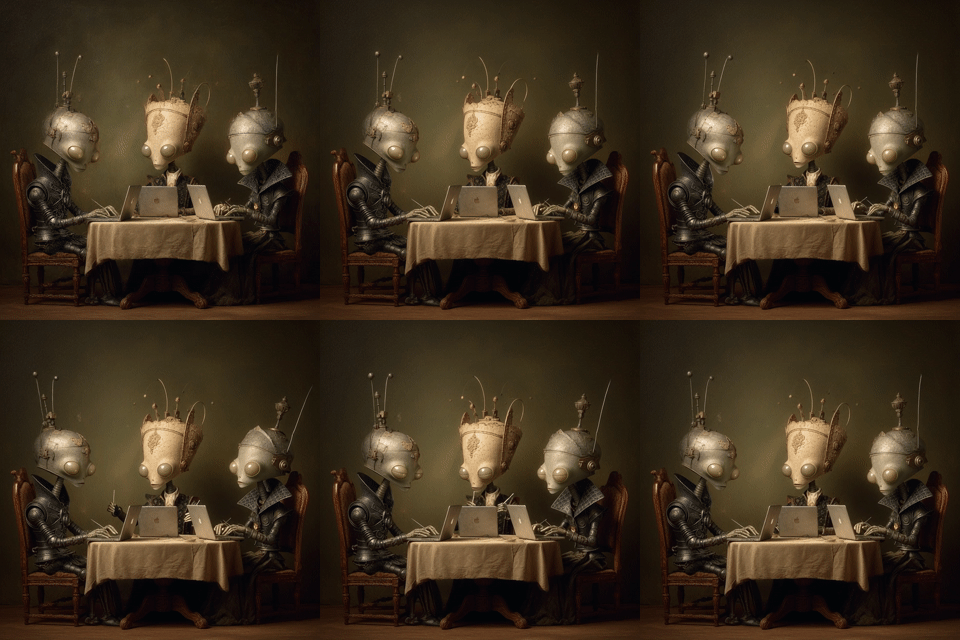
Click see a unique image and three story possibilities.